
You want to provide optimal educational experiences for your preschool child, but it is often difficult to make a cohesive plan. You have probably collected more activity ideas than you could ever use. The difficult part is deciding what to do next, how to create some balance and whether you are offering the right activities.
A simple home preschool plan can help. Young children learn through play, conversation, movement, shared routines and the questions that capture their attention. The parent’s role is not to fill every hour. It is to notice, provide thoughtful possibilities and encourage the child to explore.
In the United States, preschool usually refers to ages 3–5. The same flexible approach can also be adapted for kindergarten and early elementary children, which is why the examples here are suitable for approximately ages 3–7.
The National Association for the Education of Young Children describes effective early learning as a balance of child-directed play, guided play and thoughtful adult support. At home, that can be much simpler than it sounds: begin with what your child is already interested in. Try offering a small number of connected experiences and observe what happens.
Begin with your child’s interests rather than a checklist of subjects and skills
Before planning activities, think about what your child has been talking about, collecting, pretending, drawing or trying to understand. An interest might be butterflies in the garden, trucks outside the window, making beds for toys, pouring water, a favorite story or a question about the moon.
Choose one interest or question as a loose thread for the week. You are not committing to a formal topic. You are simply using something meaningful to help you select a few experiences that belong together. If the interest fades, you can let it go. If it grows, you can continue for another week.
Use six learning areas as prompts
Learning areas are most helpful when they remind us of possibilities. The six boxes don’t need to be included every day. One experience often crosses several areas at once.
| Learning area | Planning questions |
|---|---|
| Stories and conversation | What could we read, retell, describe or wonder about together? |
| Numbers, nature and discovery | What could we count, compare, observe, predict or investigate? |
| Making and imagining | What could the child draw, build, invent or use in pretend play? |
| Music and movement | How could the idea be explored through sound, rhythm or whole-body movement? |
| Feelings, relationships and independence | What choice, responsibility, conversation or self-help skill could be included? |
| Current projects and special interests | What is the child returning to, and how could we help the idea develop? |
A useful reminder: You do not need an activity for every area. Look across several days rather than judging one morning. A walk that includes conversation, counting, movement and observation may already touch four areas.
Plan three anchor experiences
For many families, three planned experiences are enough to give the week some shape. They can be moved, repeated or skipped depending on daily events, energy, weather and interest.
- A story or conversation. Share a book, tell a personal story, look at photographs or talk about a question together.
- An active investigation. Go outside, test an idea, sort a collection, explore water, cook, garden or examine something closely.
- A creative response. Draw, paint, build, move, make music, invent a story or set up pretend play connected to the interest.
These are starting points rather than compulsory lessons. A child may return to the investigation all week but show little interest in the planned art experience. That’s useful information for future planning.
Include ordinary life
Home learning already contains valuable experiences: preparing fruit, matching socks, watering plants, setting the table, feeding a pet, packing a bag and helping to tidy materials. These routines support language, sequencing, coordination, independence and a sense of belonging. They do not need to be formal lessons for your child to learn valuable skills.
Leave room for repetition and free play
Children often repeat an action because they are consolidating an idea or gaining control of a skill. Re-reading the same book, pouring water again or rebuilding a familiar structure can be more valuable than moving quickly to a new activity.
Keep some parts of the day unplanned. Free play allows children to combine ideas in ways an adult may not have anticipated. It also lets the week flow more smoothly, without pressure to achieve certain tasks.
A worked example for a butterfly and garden week
Suppose your child has noticed butterflies near the garden. You might choose the question, ‘How does a caterpillar become a butterfly, and what helps butterflies visit our garden?’ From those questions, a full week of learning can grow.
The three anchors
- Story and conversation: Read The Very Hungry Caterpillar, then compare this imaginative story with a photographic book about the butterfly life cycle.
- Active investigation: Spend a short time outside looking carefully for butterflies, caterpillars, eggs, flowers and other small garden creatures. Take a photograph or make a quick sketch of anything interesting.
- Creative response: Fold a painted paper butterfly in half to explore symmetry or move slowly like a caterpillar before opening ‘wings’ and flying.
Other possibilities to choose from
- Count spots, legs, flowers or butterflies, without worrying if none appear that day.
- Compare the patterns on two butterfly photographs and notice whether the wings match on both sides.
- Make a simple life-cycle sequence using four drawings: egg, caterpillar, chrysalis and adult butterfly.
- Invite the child to refill a shallow water dish with stones or damp sand, with close adult supervision.
- Look at plants that provide nectar for adult butterflies or food for caterpillars. A local university extension office or native plant group can help you choose species suited to your part of the United States.
- Set up a garden shop or insect rescue station for pretend play using paper signs, containers and toy figures.
Choose only what suits your child and your week. You do not need to complete the whole list. One book, one outdoor observation and one child-led response may be plenty.
Butterfly and bug books to look for
The Very Hungry Caterpillar by Eric Carle. A familiar starting point for counting, days of the week, sequencing and talking about change. It is a story rather than a scientific account, so pairing it with a factual book helps children compare imagination with real-life information.
Caterpillar to Butterfly by Laura Marsh. A National Geographic Kids early reader with close-up photographs and a clear explanation of metamorphosis. It is useful for children who want to know what really happens.
A Butterfly Is Patient by Dianna Hutts Aston and Sylvia Long. A richly illustrated nonfiction picture book for lingering over details, asking questions and exploring the variety of butterflies.
The Very Busy Spider by Eric Carle. A rhythmic story that can lead to web making, animal sounds and conversations about persistence. A spider is an arachnid rather than an insect, which gives older children an interesting point of comparison.
The Grouchy Ladybug by Eric Carle. A playful way to explore time, size, feelings and what happens when someone is not ready to share.
There is no need to buy all of these. Borrow one story and one factual book from the library, or use a reliable nature guide you already own.
Record observations
A few lines are enough. The purpose isn’t to assess your child. It is to help you remember what mattered and connect it with future ideas. You might jot down:
- What your child said, asked or wondered.
- What held their attention.
- What they repeated independently.
- New words or ideas they used.
- Anything that was difficult or frustrating.
- Something unexpected they noticed.
For example: ‘Mia repeatedly counted the spots on the ladybug and noticed that the butterfly’s wings matched on both sides. She asked where butterflies sleep and whether caterpillars have families.’
Let observations guide future activities
The next step comes from the observation, not from a preset sequence. From the example above, possible follow-ups might include:
- Symmetry butterfly painting.
- Looking under leaves for eggs or caterpillars without disturbing them.
- Comparing butterflies and moths.
- Counting or graphing the insects and other small creatures seen in the garden.
- Finding where butterflies rest at night.
- Planting one suitable butterfly-attracting plant.
- Making butterfly life-cycle sequencing cards.
Choose one or two possibilities. The goal is to follow the child’s thinking while keeping the week manageable. If the child has moved on, your next plan can begin with a completely different interest.
A simple weekly rhythm
If you like having a loose rhythm, try this and adjust it freely:
- Early in the week: notice an interest and share a related story.
- Midweek: offer an active investigation or outing.
- Later in the week: invite a creative response and revisit favorite parts.
- At any point: jot down one observation and one possible next step.
Some weeks will be busier and some will be quiet. Illness, appointments, weather, tiredness and family life all affect what is possible. A flexible plan aims to support your family, and give you the freedom to be flexible.
Keep the plan small enough to use
A thoughtful preschool week at home grows from close attention: noticing what your child is trying to understand, offering useful possibilities and allowing time for ideas to develop.
When you begin with one interest, choose three anchors and keep brief observations, planning becomes lighter. You are no longer searching for a new activity every day. You are building on the learning already happening in your home.
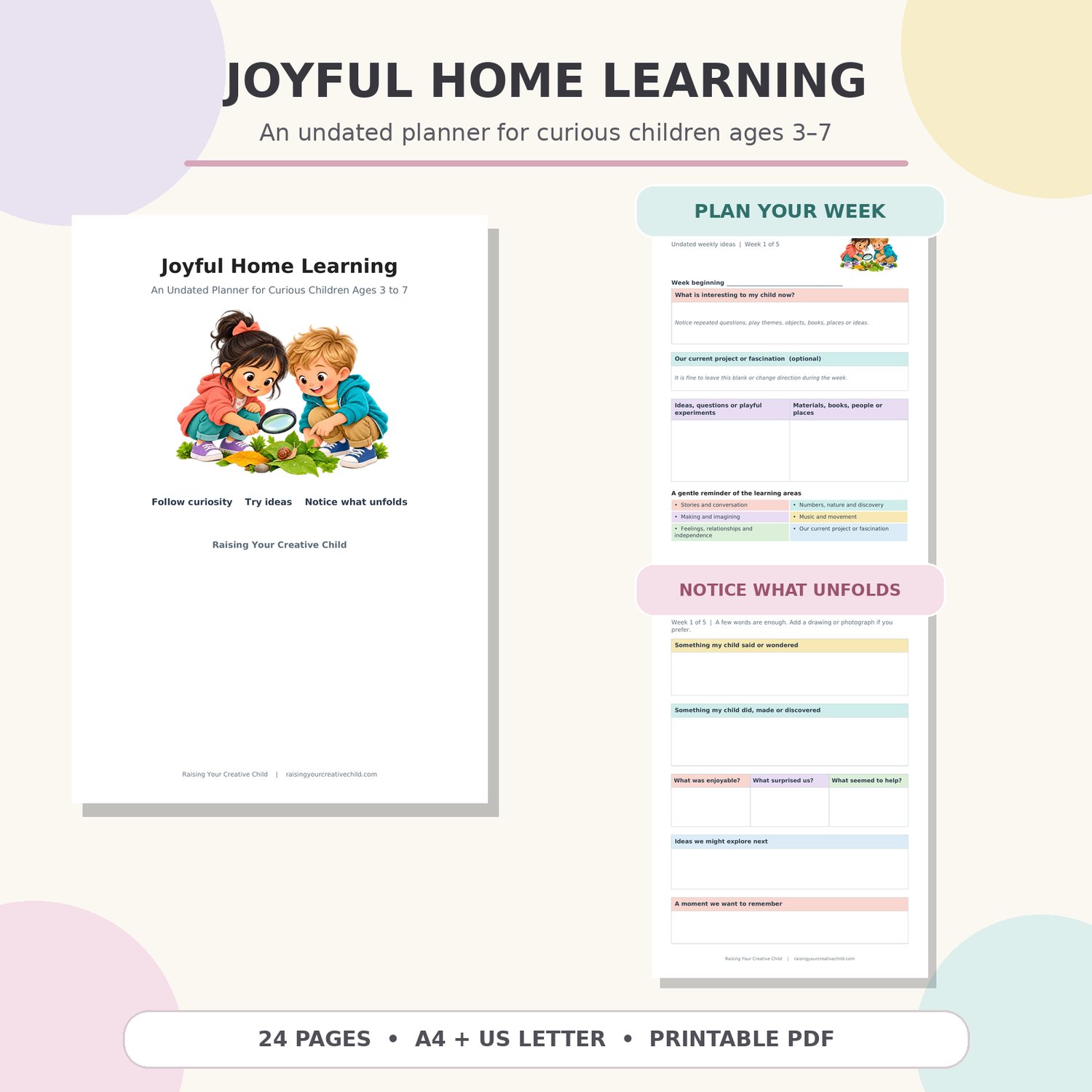
Would you like one place to collect those ideas? The Joyful Home Learning Planner includes flexible planning pages, six learning areas, space for observations and room to record possible future activities. It is designed for families of children aged 3–7 who want gentle structure without recreating school at home. Explore the Joyful Home Learning Planner.